Why Brave Opinions Won the Media at MWC 2026

Mobile World Congress (MWC) remains the focal point of the global telecoms calendar. For B2B technology brands, it represents the single largest opportunity of the year to secure Tier 1 media coverage, influence industry analysts, and position executive leadership. However, as our recent media analysis demonstrates, the sheer volume of noise at the event makes achieving meaningful cut-through increasingly difficult.
Following a successful MWC 2026, the Babel team conducted an audit of the coverage generated across 45 Tier 1 telco trade publications and select national business technology outlets during the week of MWC 2026 to understand not just what was being covered, but why specific narratives resonated with the press while others were ignored.
The data points to a clear conclusion. In a media environment saturated with consensus messaging and generic product announcements, journalists are actively prioritising spokespeople and companies that offer a differentiated, pragmatic, and sometimes challenging perspective on the industry’s most pressing issues. Taking a strong view on developments in the sector is often the best way to generate cut-through with the media.
The Dominance of AI
To understand the challenge brands faced, we must first look at the thematic data. Unsurprisingly, Artificial Intelligence dominated the news cycle, but the scale of that dominance is instructive.
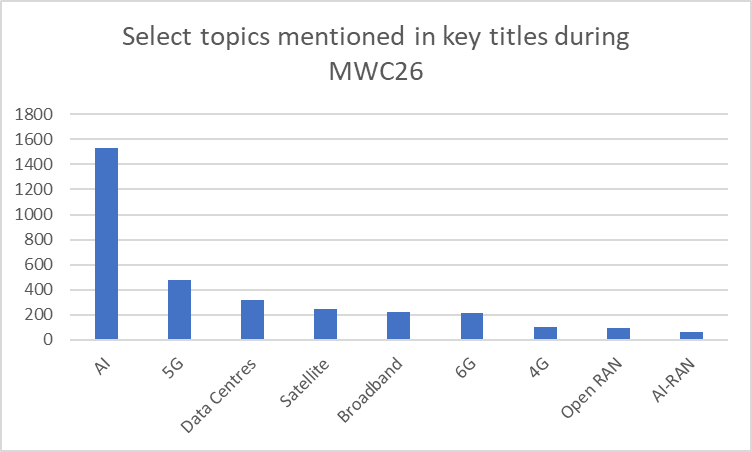
With AI generating over 1,500 distinct mentions in our media pool analysis of coverage relating to MWC - more than three times the mentions of 5G - simply having an AI-related announcement was insufficient to guarantee coverage. Almost every vendor on the show floor incorporated AI into their messaging. The companies that successfully translated this theme into high-value editorial coverage did so by moving beyond the hype and addressing the friction points of implementation.
An example of this can be seen in an article by Saskia Koopman of City AM, reflecting an interview with Ciena’s Jürgen Hatheier during MWC. He argued that connectivity failing to keep up with chip innovation meant huge investments in chips were being essentially wasted with their processing power sat idle, waiting to be communicated with. This narrative provided the financial, investor-centric weight combined with technical expertise and unique opinion that is required for business press cutthrough.
Navigating the shift to Agentic AI
A prominent narrative thread prior to the event was the concept of Agentic AI - autonomous systems capable of running and repairing networks with minimal human oversight. However, our review of the coverage demonstrates that the media was highly receptive to executives who provided a reality check on these claims.
For example, Totogi secured feature coverage in publications such as Telecoms.com by addressing the underlying complexities of AI deployment. CEO Danielle Rios cautioned that building AI at scale is not a weekend project, warning that deploying AI without rigorous data ontologies and enterprise-wide context would result in "automated chaos."
Similarly, Microsoft achieved positive, pragmatic placement in Fierce Network when its Telco Industry CTO, Rick Lievano, openly discussed the limitations the company had encountered.
He noted that using AI for massive network anomaly detection had failed to deliver the expected ROI due to complexity and false positives, prompting a strategic pivot toward rapid response use cases. By speaking candidly about what hasn't worked, Microsoft positioned itself as an experienced, credible partner rather than a vendor promising flawless solutions.
Questioning AI-RAN
Another major theme heavily promoted by vendors was AI-RAN, which is the strategy of deploying high-performance GPUs at cell sites to process AI workloads at the edge. While this generated significant momentum, the most compelling headlines emerged from those willing to question the fundamental premise.
In Light Reading, HPE’s CEO, Antonio Neri challenged the necessity of the architecture, pointing out that modern mobile devices already possess immense processing power, rendering incremental infrastructure overhead at the cell tower potentially redundant.
In the same publication, Orange CTO Bruno Zerbib expanded on these doubts with practical, operator-level concerns. He highlighted the physics constraints regarding latency between GPUs and radios, and raised a stark operational risk: installing expensive GPUs at thousands of remote mast sites presents a significant security challenge, particularly for operators already dealing with infrastructure theft.
By addressing the physical, financial, and architectural realities of AI-RAN, these executives inserted their perspectives into the centre of the news cycle, driving a more balanced industry debate.
Addressing the realities of Open RAN
Open RAN has been a staple of MWC messaging for several years, typically framed around the benefits of ecosystem diversity and the end of vendor lock-in. However, the 2026 coverage indicates that the media's tolerance for generic statements on this topic has waned.
Journalists are demanding a more nuanced assessment of Open RAN's progress. A prime example is a comprehensive feature in Light Reading examining the difficulties of building a truly virtual, open network. The executives who captured the narrative - including Vodafone’s Network Architecture Director Yago Tenorio and Nokia’s Tommi Uitto - did so by openly discussing the complexities of silicon monopolies and the trade-offs between Intel's x86 dominance and Arm-based alternatives. Acknowledging that true hardware and software disaggregation remains highly complex proved far more newsworthy than reciting standard ecosystem benefits.
The strategic imperative for communications
The telecoms sector is currently navigating significant structural and financial pressures. Journalists are acutely aware of flat CapEx environments and the challenge of monetising new network investments. In this climate, B2B tech companies that default to cautious, committee-approved messaging are limiting their own visibility.
A polite product update or a reiteration of industry consensus simply lacks the editorial weight necessary to capture a journalist's attention during a major news event. True thought leadership requires actual, distinctive thoughts.
At Babel PR, we believe that securing high-value media coverage requires a strategic approach to message development. We work closely with our clients to audit the industry consensus, align communications with actual commercial realities, and develop authoritative, opinion-led narratives. By helping your subject matter experts articulate a defensible, differentiated stance, we ensure your brand leads the conversation, rather than just participating in it.
As you evaluate your communications strategy for the remainder of the year and prepare for future industry milestones, contact the Babel team to discuss how we can help define and deploy your strategic narrative.


.png)