Is what AI knows about you helping you become who you need to be?

Your website says you’re a strategic transformation partner. So does your sales deck. So does your CEO, on stage, talking to a room full of nodding people.
Now ask an AI to shortlist the vendors in your category. There’s a decent chance it describes you as a technology implementation partner. Or a supplier for SMEs. Or - and this one really stings - a company that still sells a product you retired three years ago.
Nobody will tell you this is happening. It won’t show up in your CRM, your analytics or your quarterly board pack. But somewhere, a buyer is forming a view of your business based on what an AI is feeding them.
The problem isn’t just AI visibility. It’s brand knowledge: the gap between what your business needs to be known for and what AI, drawing on the wider information ecosystem, actually understands about you. Babel’s research found that 5% of B2B tech purchases over £50k were influenced and recommended by AI.
I’ve spent the last six months down the AI rabbit hole working out how to fix this gap. It started with Babel’s Mental Av-AI-lability research, which asked whether it’s better to be human remembered or machine recommended. Since then, I’ve looked at most of the AI visibility tools, spoken to a lot of industry leaders and, if I’m honest, given myself a headache.
So here’s where I’ve landed. If you’re a CMO being asked “what are we doing about AI?” and you’re not totally sure what the right answer is, this is for you. I’ll try to make it useful first, and chuck in a pitch at the very end. (I’ll fail slightly at that. You’ll see.)
Buyers don’t start with Google anymore
Why is this such an urgent problem? Because buyers don’t start with Google anymore.
According to Babel’s research, 5% of B2B tech purchases worth more than £50k were recommended by AI. These aren’t impulse buys. And, while five per cent might not sound like much, it’s a number that didn’t exist two years ago, which tells you something about the direction of travel.
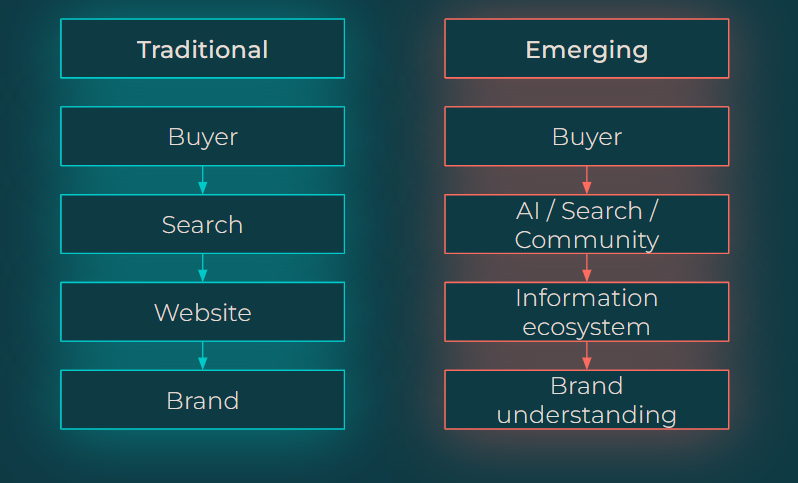
The old journey was simple. A buyer searched, landed on your website and formed a view of your brand. You controlled most of it.
The new journey looks different. A buyer asks AI (or search, or a community), the AI draws on the wider information ecosystem, and the buyer ends up with an understanding of who you are. You control… some of it.
And buyers aren’t only using AI to find vendors. They’re using it to:
- Understand unfamiliar categories
- Research problems
- Compare options
- Validate decisions
- Create shortlists
Read that list again, because most of it happens before anyone visits your website. Before you know there’s a buyer at all. By the time you’re on the shortlist, the buying criteria have already been set - and something helped set them.
SEO, PR and AI visibility tools: why none of them answers the AI question
If you’ve tried to work out what to do, you’ve probably heard one of three things.
“Good SEO is good GEO.” This comes from the SEO camp, who’ve watched search clicks fall off a cliff and understandably want a seat at the AI table. Other than sharing a similar-sounding acronym, I’d argue these are very different practices.
“To be cited is to be covered.” This comes from the PR camp (and yes, I’m aware of the irony given where I work), who argue that AI engines lean heavily on earned media, so more coverage is the answer.
“Here’s your AI visibility score.” This comes from a growing number of tools that promise a clear number to put on a dashboard.
The truth is there’s no playbook for this yet. And, to be honest, it’s the loudest voice that’s winning right now.
Here’s how I’d separate them:
- SEO optimises pages to rank for queries. Success is rankings and clicks.
- GEO, as it’s usually sold, optimises to be mentioned for prompts. Success is a visibility score.
- Brand knowledge looks at the whole information ecosystem. Success is closing the gap between what you want to be known for and what AI believes.
I’m going to be a bit blunt about the third one, because it’s the one most likely to land on your desk.
AI visibility tools work by taking a large list of prompts, running them through the AI models and counting how often your brand appears. Then they give you a score. It’s neat. It’s measurable. It looks great in a board pack. And we marketers love a number - we’ve been raised on CRM stats, LinkedIn Campaign Manager, Meta and Google Analytics, and every strategy we run needs data to justify the spend.
But I have two bones to pick.
Bone one: the scores are fragile. Most of these tools are testing a big set of prompts and using probabilistic scoring to decide whether you show up. The score doesn’t include the context of the person asking. And we all know how a small tweak to a prompt - or a bit of business context sitting in an AI’s memory - can completely change the answer. A score built on that is a thermometer, not a diagnosis. It tells you that you might have a temperature. It doesn’t tell you why.
Bone two: they’re looking at the end of the funnel. When the tool shows you which sources got cited, you’re looking at the very last step of the process. Not long ago everyone was saying Reddit, Wikipedia and the trade press were critical for visibility. Then I looked at the data.
In Babel’s AI benchmark for a B2B technology client, 55% of the top 20 sources cited for unbranded prompts were provider websites.
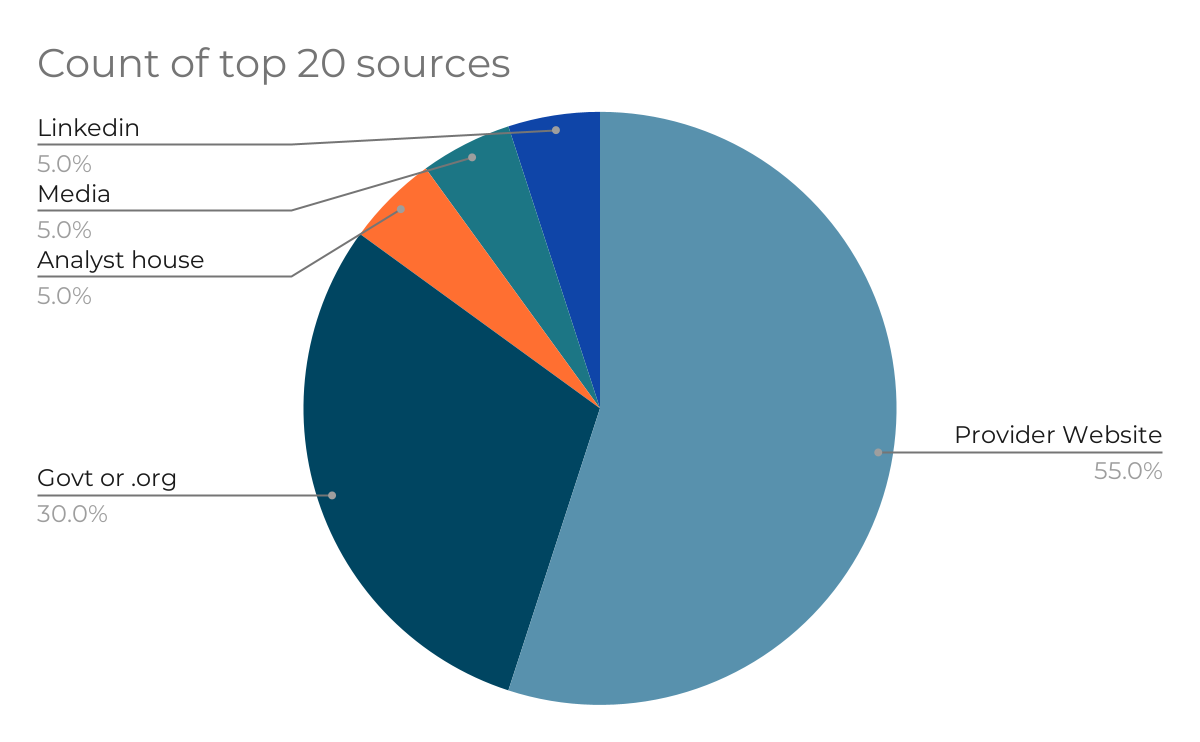
That’s one benchmark and one client, so treat it as a signal, not a law. We’ll publish more as we run them. But it makes sense. B2B tech is a niche market, there isn’t heaps of independent information out there, and there’s a vast amount of vendor-published material for AI to get its hands on.
Which means the citation you’re delighted with might not be there because you landed a piece in a particular publication. It might be there because of the category definition you shaped much earlier, upstream, long before anyone typed in a prompt that mentioned you. Tracking citations at the bottom of the funnel is a bit of a fool’s errand. The better play is to shape the category, not the final recommendation. If AI understands your category early on, and understands you within it, your chances of making the shortlist when the citations finally appear are far better.
Are these tools useful? Yes. I’m not telling you to bin them. But they’re the secondary measure - the thing that tells you whether your work is having an effect. They’re not the strategy.
Which brings me to the bigger question: are we even asking the right thing?
The better question: what does AI understand about your brand?
Right now the GEO question is: “How do we get AI to mention us?”
I think the better question is: “What does the information ecosystem actually understand about us and our category?”
Why does that matter? Because the first question sends you down the old SEO route. You have to guess the right prompt, then produce volumes of content to optimise for the prompts you think people are asking. You end up overcomplicating your content estate and chasing a moving target.
The second question starts from how AI actually works. AI is a synthesis engine. It doesn’t read one page and make a decision. It pulls information from lots of places, cross-checks it, and builds a picture.
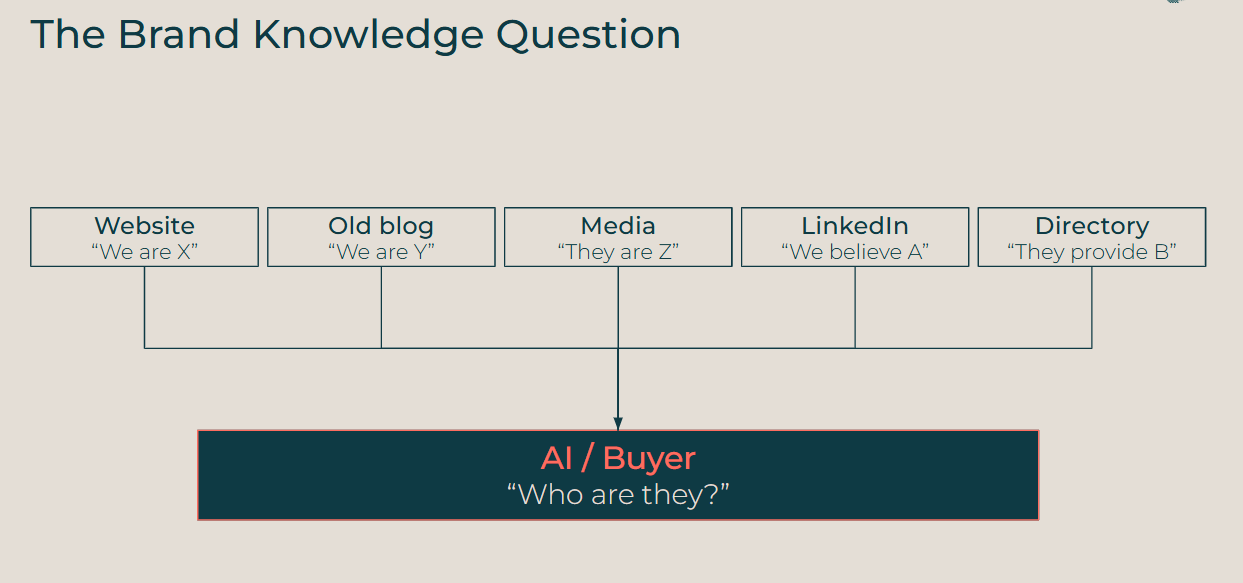
So imagine that picture is built from five sources:
- Your website says: “We are X.”
- An old blog from 2019 says: “We are Y.”
- A media article says: “They are Z.”
- Your LinkedIn page says: “We believe A.”
- A directory says: “They provide B.”
The AI - and the buyer using it - is trying to answer one question: “Who are they?” If the answers don’t line up, the picture gets muddy. And a muddy picture is much easier to commoditise.
Your brand is becoming a body of knowledge
Every webpage, article, expert, interview, social post, review and research report contributes to how your organisation is understood. In B2B, where brands, services and products are more niche, your owned knowledge plays an even bigger role in how an AI understands you.
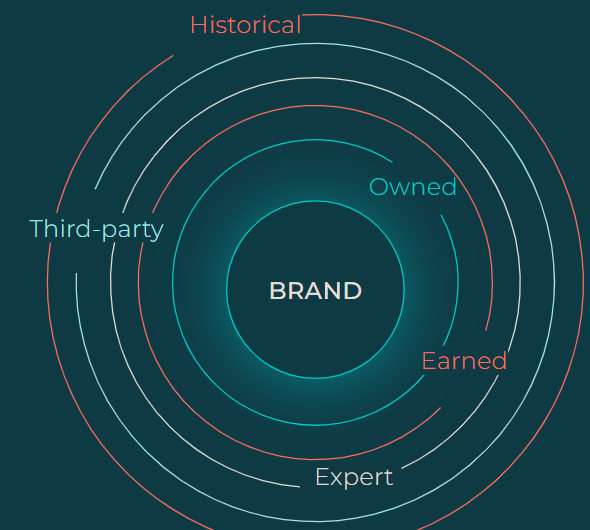
I think of it as a brand AI orbit, made up of five kinds of knowledge:
- Owned knowledge: your website, content and product information. The bit you control.
- Earned knowledge: media coverage, industry commentary, awards.
- Expert knowledge: your executives, subject matter experts and thought leadership.
- Third-party knowledge: reviews, directories, partners and platforms.
- Historical knowledge: legacy content, old messaging and retired products. The bit nobody remembers publishing, and AI never forgets.
That last one is a quiet culprit. Most B2B tech companies I speak to have years of content behind them. Each version of the business, each rebrand, each pivot is still out there, and it all contributes to the picture.
And here’s the strategic problem. No marketing team controls this entire environment. Which means your positioning is no longer simply what you say about yourself. It’s continuously reconstructed from the information available about you.
So you end up with gaps like these:
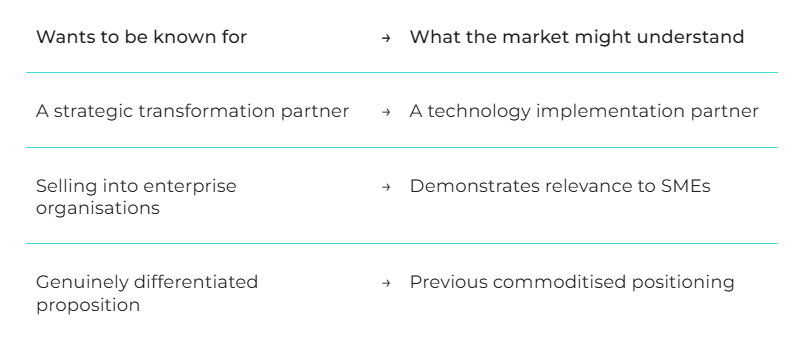
These aren’t brand problems. They aren’t content, PR, SEO or GEO problems either. They’re knowledge alignment problems. And if we don’t fix them, the way our companies get portrayed will be very different from how we expect.
So what is brand knowledge?
I’ll put it as simply as I can:
Brand knowledge (as Babel defines it) is the collective understanding created by the information available about an organisation.
It’s shaped by what you say about yourself, what others say about you, what evidence supports your claims, what information your audiences actually encounter, what third parties validate, and what AI systems can retrieve, synthesise and represent.
No single channel controls it. It lives across the whole information environment. So, our job is to understand whether that environment supports, or gets in the way of, the business you’re trying to build.
The Four Pillars
To assess how brands are perceived, we look at four things. Not to score them, but to find the gap. (More on that in a moment.)
Clarity
Do people and machines understand us?
Simple question. Very hard to answer - I’ve run enough positioning workshops to watch the misalignment happen in real time. You need to be able to say who the organisation is, what it does, who it serves, what problem it solves, where it fits and why it matters.
This isn’t a 48-page dossier. It needs to be succinct, choiceful and focused. The bigger and more complex your organisation, the harder this gets.
Here’s the guardrail I use to stop the “we do everything for everyone” trap: where is your biggest commercial growth opportunity over the next one to three years? Which segment will make the biggest impact? That doesn’t mean ignoring everyone else - they can be served through landing pages and your wider content. But to own a segment you need positioning that clearly appeals to it. Positioning can change, and AI can understand an evolution, but without focus your biggest strategic risk is confusion.
Distinction
Do we stand for something?
In a world of AI, sounding the same as everyone else is a pretty reliable way to be ignored. AI is far more likely to pick up something that adds a new idea, new evidence or a new perspective than another page saying what ten competitors already say.
So: do you actually stand out? Or are you using the same blue wrapping paper as everyone else with a few sparkles added here and there?
If you sound like everyone else, the biggest risk isn’t just being ignored by AI engines. It’s commoditisation. And that’s a much bigger problem than missing out on a citation in a top-ten prompt.
Alignment
Are we telling the same story everywhere?
I’ll say it again: AI synthesises. If your story isn’t aligned, you’re adding to the confusion.
If your website says you’re an expert in AI governance but your PR is talking about AI hacks, the machines don’t know whether to put you in the cybersecurity bucket or the regtech bucket. Issue-jumping is a major culprit here, where PR teams chase any story to bulk up coverage and hit KPIs. (Yes, I know. I work in PR. We can do better.)
The test is: does the information available about you support the business you’re trying to build? If not, you’re fragmenting your message and making it harder for people and machines to work out what you’re actually trying to do.
Influence
Is the right knowledge actually reaching the market?
You can have a clear, distinct, aligned message and still be invisible if it isn’t where audiences form their understanding. Influence is about your content estate, media coverage, third-party validation, the expertise and authority of your people, and the conversations happening in your category. If you’re not getting the word out far and wide, you risk irrelevance.
The brand knowledge gap: what you want to be known for vs. what AI believes about you
Here’s the idea that ties it together.
The four questions above aren’t about giving you a score out of ten. They’re about finding your brand knowledge gap:
- Desired knowledge: what the organisation strategically needs to be known for.
- Current knowledge: what the available evidence suggests it’s currently understood to be.
The gap between the two is what holds back growth. And once you can see it, you can start asking the questions that actually matter:
- What do we want to be known for?
- What are we currently known for?
- Where does the gap between the two exist?
- What’s causing or reinforcing the gap?
- Which gaps matter commercially?
- What should we do about them?
- What’s the next Brave move?
That last one matters to us. We don’t want to hand you a list of 47 marketing recommendations. We want to work out the one strategically significant decision sitting behind all the activity - the move that changes how the market understands you.
What this looks like in practice
Here’s an illustrative example (this isn’t a client, but it shows the shape of the output).
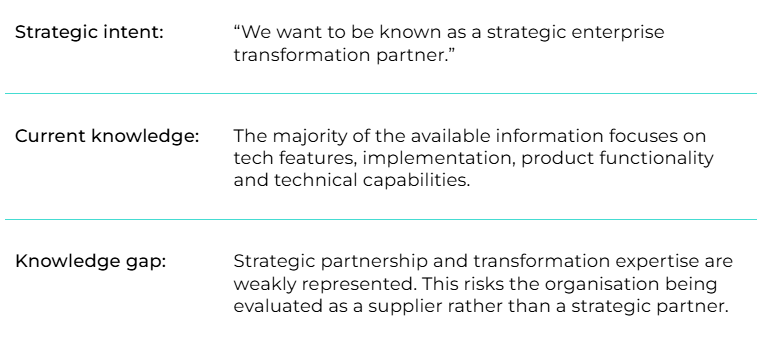
We’d rate the evidence behind each association as strong, developing, weak, absent or contradictory. In this illustration, the overall assessment is weak: of 298 pages reviewed, 61% were weak or critical. Extractability and quality scored reasonably, but differentiation (40%) and currency (38%) were the real problems.
Notice what that tells you. It isn’t “publish more content.” It’s “the evidence supporting the position you want simply isn’t there.” That’s a very different conversation to have with your CEO and your board, and a much easier one to justify.
Then comes the bit I care about most: prioritisation. We rate each gap against commercial impact (how significantly it could affect growth), strategic importance (how important it is to the future business), urgency (how quickly it needs action) and changeability (whether you can realistically influence it). We’re not interested in a long list. We’re interested in what matters most.
Why this works as a way to approach AI: no prompt hacks, no probabilistic guesswork - a strategic diagnostic of what’s shaping your brand knowledge and how AI understands and recommends you. This is what I think we should be tracking first and foremost. AI visibility and audits come second, as the mechanisms that tell you whether the work is landing.
Is this you?
Not every business has this problem to the same degree. In my experience, the brand knowledge gap bites hardest when you’re:
- Repositioning or moving into a new category
- Expanding into enterprise or moving upmarket
- Expanding internationally
- Integrating an acquisition
- Welcoming new leadership
- Fighting commoditisation in a crowded market
- Carrying years of legacy content and messaging
- Fielding questions from your board about AI discovery and representation
If two or three of those made you wince, keep reading.
The questions I’d be asking if I were you
I know this is new. I know it’s not obvious what the “right” first move is. And I know nobody wants to make the wrong one in front of the board. So let me answer the questions I’d be asking.
Is this just another AI visibility report? No. Anyone can give you a visibility report. This is a strategic diagnostic: what do you want to be known for, what’s the evidence for what you’re actually known for, where’s the gap, and what should you do about it.
How do I control what AI says about my company? You can’t control it directly. You can shape the information it draws on. That means working out where your owned, earned, expert, third-party and historical content disagrees with the business you want to build, and fixing the gaps that matter most. That’s what the Snapshot is for.
Do I need a finished positioning before we start? It helps, because we need something to compare against. If you already have clear strategy, positioning and messaging, we’ll turn it into a structured picture of what you want to be known for. If you don’t, we’ll tell you - and that may need a separate piece of work. That’s a finding in itself, not a failure.
Will I get a list of 47 recommendations? No. A list isn’t a decision. We’d rather give you a clear view of what matters most and what to do next.
Does this replace my SEO, content or PR agencies? No. If anything, it tells them what to point at. Most of the confusion in this space comes from everyone working on their own piece of the puzzle with no shared view of the whole.
What if it tells me something I don’t want to hear? It might. That’s kind of the point.
What do I need to give you? Someone who can tell us what the business is trying to become, and access to your existing strategy, positioning and messaging. We do the heavy lifting.
Where we are today (and why I’m not going to sugar coat it)
Like everyone else, we’ve been playing with all the tools - distracted by the promise of a clear picture of what to do. All it did was increase the complexity.
So we took a step back and thought long and hard about brand knowledge in the AI era. Now we have a hypothesis, a methodology and a clear direction for helping brands with what we call algorithmic availability - the likelihood that AI systems can understand, represent and recommend your brand with confidence.
But we’re early. There will be things we learn and things we get wrong, as with any new approach. That’s exactly why we’re working with a small number of founding clients and why the price reflects it.
It won’t be long until others catch up, so this is your chance to get a head start and own your category in the AI-driven buying journey.
Your first move: the Brand Knowledge Gap Snapshot
If you’re apprehensive about making a big move, good. Don’t. Start with something proportionate.
The Brand Knowledge Gap Snapshot is the quickest way to find out whether you have a knowledge problem worth investigating. It looks at the information you control and tells you what it currently says about you.
What’s included:
- A strategic intake with us, so we understand where you want to go
- A high-level view of how your owned information environment (website, core pages, selected content and existing messaging) comes across
- An assessment against Clarity, Distinction and Alignment
- Key observations, significant inconsistencies and potential risks
- Initial opportunities
- A recommended next move
What it deliberately isn’t: a full analysis. The Snapshot doesn’t include comprehensive third-party or media analysis, full competitive analysis, a complete AI representation analysis or a full Gap Map. That’s intentional. It’s designed to answer one question - do we have a gap worth investigating? - without asking you to commit to a big programme to find out.
Founding rate: £5,000 (usually £6,500) for a small number of founding places.
And if the Snapshot shows a gap worth closing? The next step is the full Brand Knowledge Gap Analysis: your desired knowledge profile, a complete picture across owned, earned, third-party and AI sources, a Gap Map, prioritised opportunities and a 90-day roadmap for one Brave move. We’re also working with a handful of design partners on the full Gap Analysis at a preferential rate. If that’s the conversation you want to have, tell us and we’ll talk it through.
What the F can you do about it?
Stop treating AI like another score you can put on a dashboard. Start treating it as a knowledge problem. Work out what you want to be known for, find out what you’re actually known for, and be brave enough to deal with the gap.
If you’re a B2B tech CMO or marketing lead in the middle of a repositioning, a move upmarket, an acquisition or any strategic change - and you’d rather know than guess - [book a conversation about the Snapshot].
Because the riskiest move isn’t the wrong one. It’s waiting while AI forms its opinion of you without you.