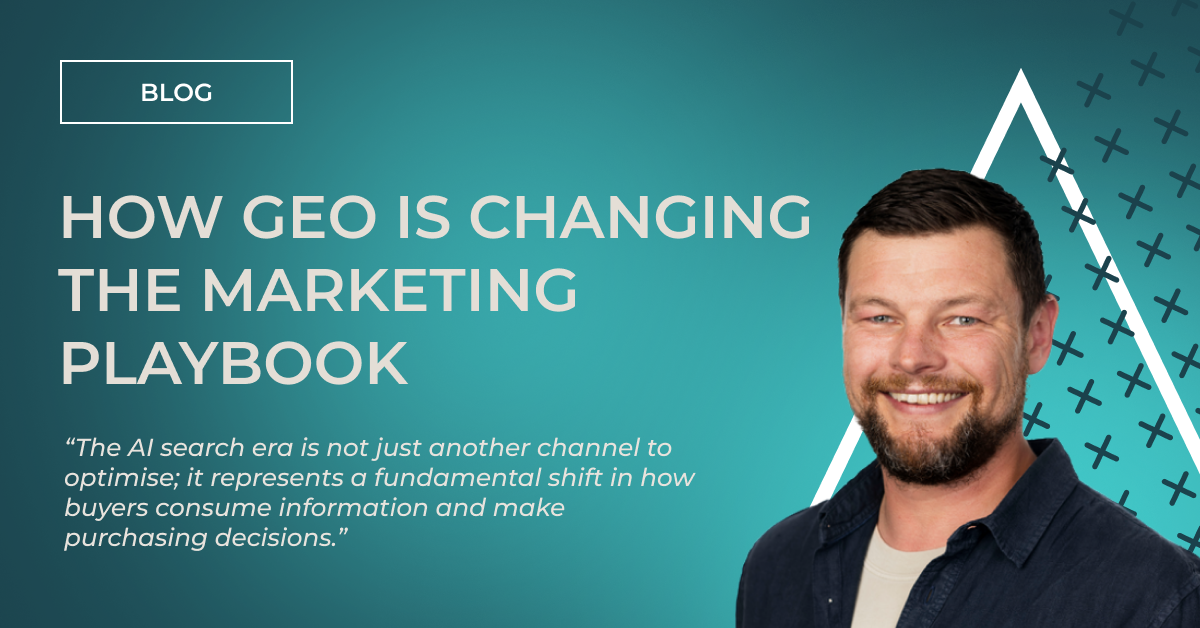
The Brave Guide to AI Search: Why GEO is Just Good SEO

I get asked about Generative Engine Optimisation (GEO) almost every day. B2B buyers are changing how they buy. They're using AI to make high-stakes purchasing decisions. And it has left marketers scrambling.
But let's be honest. AI search has thrown the cat amongst the pigeons. And the GEO bros peddling plain-text website hacks are just making it worse. It is garbage advice.
So, I sat down with Alice Widger - the Kate Bush of SEO - on our Back to Brave podcast to set the record straight.
Here is what you actually need to do to stop playing it safe and start winning in the AI era.
1. GEO is Just Good SEO
Stop trying to game the system. There are no hacks. Building a plain-text version of your website is a massive waste of time.
Alice runs MilkIt Digital with a strictly no-nonsense approach to search. And she explains it perfectly. AI models learned how to crawl information from search engines. So the foundational principles of AI search are exactly the same as traditional SEO.
Winning at AI search means fixing your core SEO pillars.
- Keep your content consistent. Tell the exact same story across every platform. This is how the machine learns to trust you.
- Prove your expertise. Give them evidence of your Experience, Expertise, Authority, and Trust (EEAT).
It sounds simple because it is. If your user experience is smooth and your content is genuinely educational, you are already in a great position.
2. Tear Down the Gates
Your gated content is killing your demand generation. I cannot emphasise this enough.
When you put a form in front of your best thinking, you block the machine from reading it. Bots won’t index you. They won’t reference your brand. And worse, they might just hallucinate facts about you to fill the gaps.
Alice nailed it. If it is gated, you are basically telling search engines and buyers to go away.
And quite frankly, asking prospects to hand over personal data before you have built any trust is just a fast track to a CRM full of garbage contacts. It takes guts to step away from the MQL obsession. But we need to stop confusing contacts with high-intent leads.
So, what does this look like?
- Ungate your expertise. Give your content away generously. Let the 95% of buyers who are out of market educate themselves and build mental availability for your brand.
- Focus on high intent. Reserve your forms for the 5% who are actually ready to buy. Use clear actions like booking a demo.
3. PDF at Your Peril
Think twice before dumping your best content into a PDF.
Yes, PDFs can be indexed. But they strip away all the context your website delivers. They lack the navigation, the brand personality, and the proof of expertise that surrounds your standard web pages. If an AI bot lands on a standalone PDF, it misses the bigger picture of who you are.
The fix? Build proper HTML pages. Search engines and AI models are built to read HTML. It helps them understand your structure, your headings, and your FAQs. It gives them exactly what they need to piece together your story.
4. Stop Chasing Prompts
Marketers are obsessed with guessing exactly what prompts buyers are typing into ChatGPT. Newsflash: it is a complete waste of time.
Prompts are like long-tail keywords on steroids. They are entirely unique to the individual. You will never catch them all.
Instead, do this:
- Focus on search intent. Build topic clusters around your core services.
- Talk to sales. Find out what questions your buyers are asking every single day. What are their actual pain points?
- Answer clearly. Build content that solves those exact problems. And put it in plain sight on your website.
5. Beef-Up Your Case Studies
B2B is H2H. We are marketing to human beings with emotional drivers and fears. They make decisions emotionally, then justify them with logic. They want proof you can actually do what you say you can do.
A flimsy two-sentence quote at the bottom of a page does not cut it anymore. It devalues your brand.
Your buyers want details. And so does AI. They both want in-depth case studies that pinpoint the exact problem and how you solved it. They need stories that back up your brand positioning.
Playing it safe in a sea of sameness is commercial suicide. Stop hiding your best work and start proving your value.
Ready to stop ticking boxes and start building real demand? Dive into the full conversation with Alice Widger and uncover the brave moves you need to make right now.
Listen to the full episode of the Back to Brave Podcast here
.png)