Businesses in ChatGPT: a chance to reclaim your message

TL:DR: On 10 November 2026, OpenAI launched Businesses in ChatGPT, a beta programme that lets businesses claim and verify a profile in ChatGPT, manage the information it holds and see aggregated insights on mentions and website clicks. It won’t guarantee you more recommendations. But it’s a very good reason to get your messaging clear, consistent and distinctive.
For years, marketers have invested heavily in defining their brand, controlling their messaging, and making sure their business is represented consistently across every channel. Then AI search came along and started telling your story for you.
With advertising now part of the ChatGPT picture, my suspicion is that this launch is a move to grow the commercial opportunity on the platform. But whether or not business profiles are part of a wider advertising strategy, they introduce something marketers have been waiting for - a degree of baseline control.
Even if you never plan to advertise, claiming your profile gives you the opportunity to provide accurate information about your organisation, manage key details, and understand how people are discovering your brand. For eligible businesses, it’s a no-brainer.
Just don’t mistake it for a guarantee. Nothing about the launch promises that ChatGPT will recommend you more often, or that it will describe you exactly as your profile does, word-for-word. Why? Because ChatGPT still has to balance monetisation with independent recommendations. If users start to think what they're being served has been bought, they'll turn to an alternative platform.
Think of claiming your business as the administrative step. Making sure ChatGPT, and the wider digital ecosystem, have an accurate, comprehensive, and useful understanding of your business is the ongoing marketing opportunity.
What does claiming your business involve?
A quick note on names, because OpenAI hasn't made this easy. Businesses in ChatGPT is the programme. Business Hub is the dashboard where you claim and manage your profile. ChatGPT Business is something else entirely: a paid workspace plan for internal teams.
To claim your profile, you search for your business in Business Hub and verify your connection to it via DNS or a domain email. Reports suggest identity verification is also needed before you can edit anything or see insights, and OpenAI reviews changes before they go live. Don't expect instant results.
A few things worth knowing before you start:
- It's a beta. Details are still emerging and will change.
- Eligibility: Any eligible business with a website, in a region where ChatGPT is available, can claim a profile.
- Business Agents are US-only for now. They're currently limited to eligible US e-commerce and online service businesses, so for most UK/European B2B tech brands, the profile and insights are the relevant parts of this launch.
- Terms: Digiday reported that OpenAI rewrote the Business Hub terms after early concerns about the legal language, so read them before you accept.
The administrative step opens the door to a messaging review
I cannot stress it enough - a consistent, clear and distinctive brand description is one of the strongest signals that LLMs look for.
Vague, generic marketing language that leaves human readers scratching their heads to work out what you actually do has the exact same effect on machines. The more a model has to guess, the more likely it is to miss you, ignore you, or confuse you with someone else. If your description could apply to hundreds of other companies, what reason does a model have to distinguish you from them?
You must have a clear description of:
- Who you are
- What your business does
- Who your customers are
- Which industries or markets you serve
- What makes your offering different
- Where you operate
A statement like: “We are a leading provider of innovative business solutions, helping businesses optimise their productivity,” will get you absolutely nowhere.
While this might be an exaggeration, I would urge you to look at your one line business description and make sure it passes the Ronseal test (it does exactly what it says on the tin).
A much better statement would be something like: “We provide cloud-based workforce management software for mid-market and enterprise organisations, helping HR and operations teams automate workforce planning, improve employee productivity and manage operational costs.”
Or, for a cybersecurity brand: "We provide managed detection and response for mid-market financial services firms in the UK and Europe, helping security teams spot and contain threats around the clock without building their own operations centre."
It might not sound sexy, but that's the job of your advertising and copywriting on your website. AI systems, just like people trying to understand your business for the first time, need a descriptive, meaningful, and easily understood explanation of what you do.
This clarity is easily lost the moment a Ronseal description goes internal. As soon as anything comes from marketing, other departments start expecting a shiny slogan or tagline. They've all watched Mad Men. The problem is that this leads teams to skip the important step of just telling their story straight. No frills. No fun. Just a clear articulation of who you are, who you serve, and what you do.
Don't skip this step, and don't allow yourself to be forced to "make it more marketing". This is the essential information LLMs need to understand you, and it's the foundation for telling a creative story afterwards. Get internal alignment on the basics before doing anything else. In my experience, that's often harder than you might think.
Messaging nailed, now it’s time for consistency
LLMs are synthesisers. From their training data and live web searches, systems draw on multiple sources of information about a business, identify common themes, and reconcile different descriptions to come back with an aggregate point of view.
If you have inconsistent company descriptions, website addresses, product names, or contact details, it becomes much harder to establish a clear and accurate picture of your business. Claiming your profile is a good excuse to align your business information across every channel. Same description. Same message. Same story.
This is where Generative Engine Optimisation (GEO) comes into the conversation. GEO is the practice of improving how your business, products, and expertise are understood and surfaced by generative AI platforms. It considers how AI systems interpret information and use it to formulate answers.
This means reviewing:
- Your website
- Your LinkedIn company page
- Google Business Profile
- Industry directories
- Partner websites
- Review platforms
- Boilerplates and bylines
- Other authoritative online sources
Essentially, anywhere your business shows up. (You might spot that Wikipedia isn't on this list. That's deliberate. Wikipedia is a lagging indicator of reality. You need a significant number of independent secondary sources saying the same thing before you can request edits to your page.)
Don't forget the internal dimension. Marketing defines the proposition. Communications builds reputation. PR generates third-party validation. Sales translates it into customer conversations, and product teams define what is actually delivered. If those stories don't align, AI systems encounter conflicting information. More importantly, so do your customers.
Optimise everything for the machines
So, you've claimed your business profile and started aligning your information across the digital ecosystem. The next step is ensuring your website is structured in a way that makes it easy for people and AI systems to understand.
For B2B technology businesses, I recommend reviewing the following:
- Homepage: Does it clearly explain what you do and who you serve? Is it aligned with the business description you've established?
- About us: Does it establish your company's expertise, leadership, and credibility?
- Product and service pages: Do they explain features, benefits, use cases, and target audiences without hiding behind jargon?
- Case studies: Do they demonstrate measurable customer outcomes? Can a reader understand the problem, the solution, and the results?
- FAQs: Have you identified and answered the commercial, technical, and implementation questions prospective customers commonly ask?
- Policies & Contact: Are your commercial details accurate and accessible?
- Landing pages: Does each one, even when specific to a target segment, tell a consistent, aligned story?
Then it is a case of making sure your pages have the appropriate structures for AI extraction.
Useful schema types include:
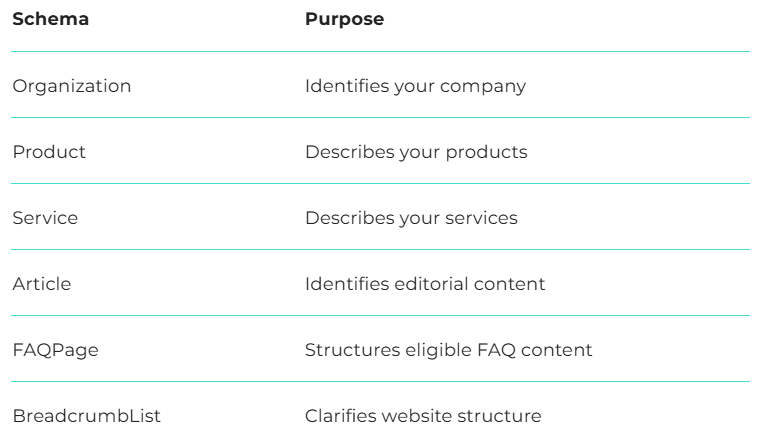
Structured data helps search engines interpret your content. It doesn't guarantee that ChatGPT will use or prioritise it, but it helps. Use it where it accurately reflects the content of the page, and where it doesn't break the human experience.
Measuring your visibility
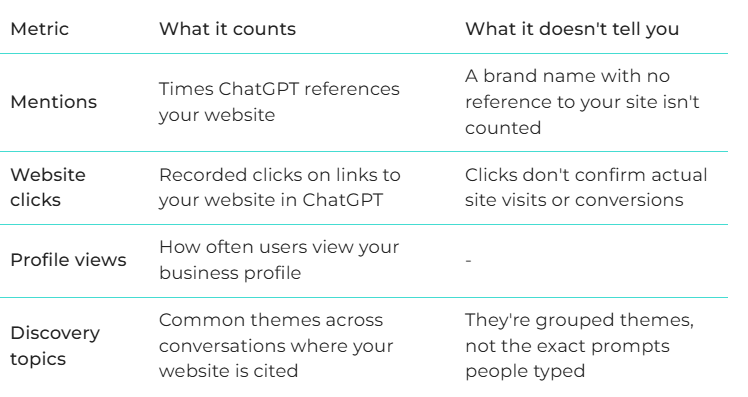
One of the most anticipated parts of this launch is the ability to access insights into how people engage with your business on the platform. Search Engine Journal shared its own early numbers: 353,356 mentions and 2,663 website clicks between 14 October and 10 November. That's a click-through rate of roughly 0.75%. Visibility and traffic are very different things.
Insights show aggregate activity over the past 28 days (there's also a 7-day view).
For a B2B marketing and communications team, it is easy to treat claiming your business on ChatGPT as simply another directory listing to tick off and forget.
But look at it differently. It's an opportunity to take a step back, challenge the way you describe your business, and make sure everyone - from your website to your sales team - is telling the same story. Because if you can't clearly articulate who you are, what you do, and why customers should care, you can't expect an AI model to do it for you.
You can't reclaim a message you haven't properly defined in the first place.
Here's what I'd do this week:
- Write your one-line description and run it past the Ronseal test.
- Get internal alignment on it before anyone makes it "more marketing".
- Claim your profile in Business Hub, then audit every place that description should appear.
If you'd like a second pair of eyes on your messaging, get in touch with the team at Babel.