“Real journalism” is the comeback of the season - and thought leadership's got a second wind
.png)
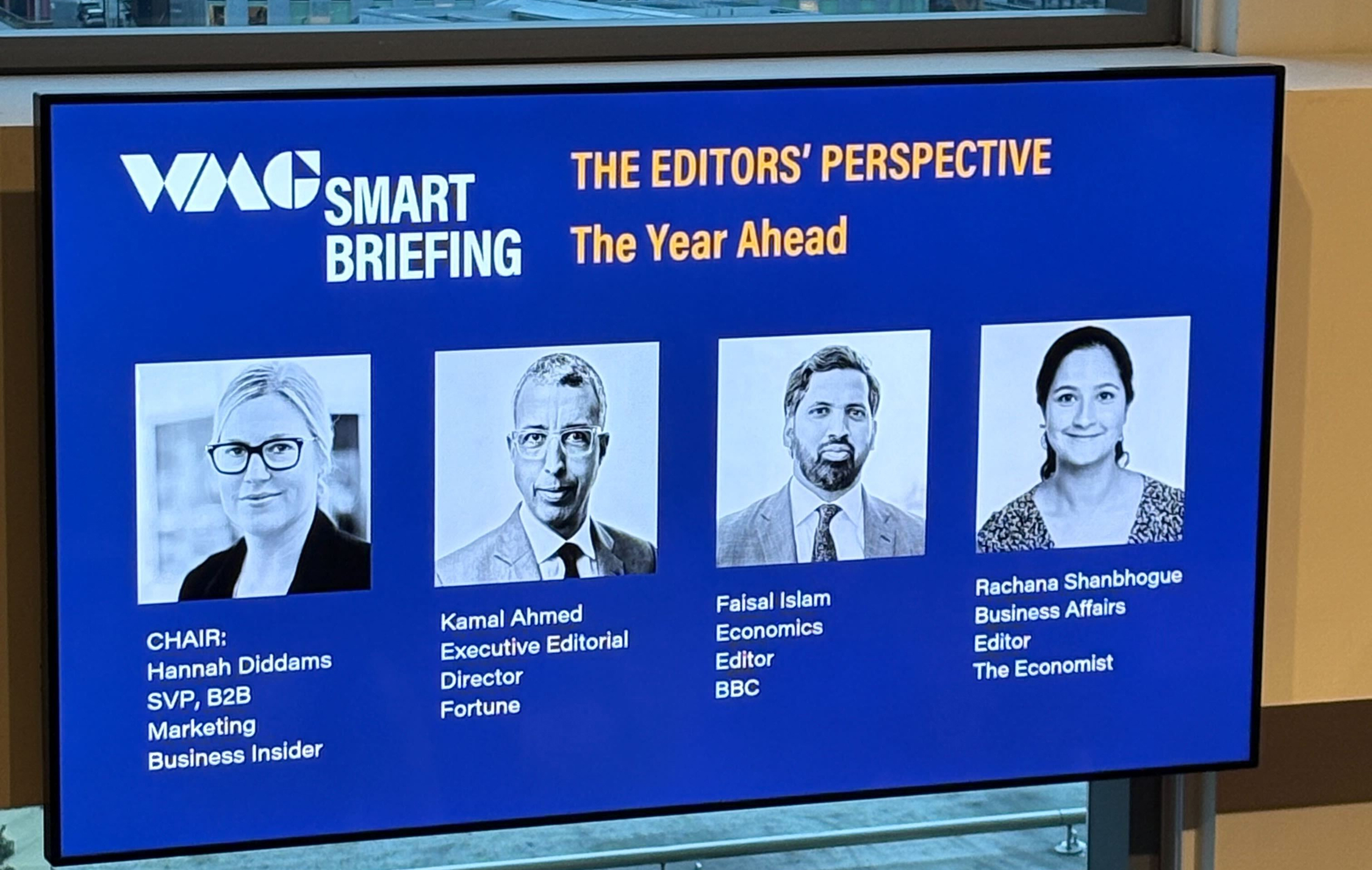
When I took the last seat of the World Media Group’s ‘2026 The Year Ahead’ event last month - having gotten lost because new buildings are hard to find their way around - I didn’t know what to expect.
What knowledge was about to be bestowed upon me from the likes of Faisal Islam, of BBC fame, or Rachana Shanbhogue, Business Affairs editor at The Economist? Would I uncover some salacious gossip about what happened at the World Economic Forum? Kind of! It was all very exciting.
What I did know to expect, though, is that AI would be on the tips of everyone’s tongues. After all, when is it not, these days?
AI, a topic that feels as though everyone is eager to run towards it, but with no end goal in sight - how could there be, with a technology that seemingly evolves past belief every few working days? However, when the conversation turned to its impact on journalism, I was surprised to hear such determined optimism from the panel. In fact, one so boldly stared into the belly of the beast and pronounced…
“Journalism is SO back!”
In a time where it feels as though AI slop, as it’s commonly referred to, is flooding every possible media channel, it’s easy to become concerned about the state of modern journalism. After all, it's not uncommon for the general public to be tricked by whatever nonsense has been spewed out by the machine.
However, it was exciting to hear that real high-quality journalism is making a return, with ‘human journalism’ acting as a watermark for credibility. As more and more individuals become attuned to picking out AI in a lineup, it’s evident that audiences are beginning to abandon the fad of low-quality, automated content. For a PR, this means a lot. After all, real and human journalism is the equivalent of real, human thought leadership for us PRs.
Computer says… Too Much
In PR, there are plenty of discussions around what ‘good thought leadership’ looks like. The consensus is that good, effective thought leadership will be written by a human, and read like one, too. When looking down the barrel of the content gun, AI has given many an easy out - why not plug a prompt into the likes of ChatGPT or Gemini and have them do the heavy lifting for you! Unfortunately for this ‘quick fix’, AI doesn’t have that human touch.
Quite often, when prompted to write an article or comment on a subject, AI will pull in too much information, covering far too many bases - and no one likes a know-it-all!
In a thought leadership article, there’s no point in trying to cover every aspect of a topic, with highly technical language and formalities strewn throughout. When you try to say everything, you end up saying and landing nothing. More importantly, though, is that by doing this, your writing leaves no room for perspective or opinion.
With the return of ‘real journalism’, it’s evident that, when reading an article, people want to know there's a face, a brain, and most importantly, a voice behind what’s being said. Your perspective and opinion are the exact thing bringing readers to your soapbox!

Don’t Skimp on the Thought Leadership
Clients get it in the ear from us all the time, but quality thought leadership is maybe the most important PR trick.
Yes, a consistent press office and news pipeline will help build a company's credentials and presence in the media - but it can’t work alone. A concerted effort must be made to develop spokespeople's profiles in the media, positioning your senior team as the voices to listen to in these highly saturated and, quite frankly, noisy markets.
This return of ‘real journalism’, where audiences are returning to reading (and trusting) long-form, highly informative content - rather than a miscellaneous post on X - is a sign from the thought leadership gods. A sign that tells us that, by prioritising effective, human-written thought leadership content, brands will succeed in reaching audiences and creating a market voice that people actually listen to.
That isn’t to say that the powers of AI can’t be a guiding light in these otherwise foggy times, though.
GE-Oh Yeahhh!
Ultimately, we exist in a world where LLMs have become search engines, with GEO being the new emerging buzzword for anyone interested in manipulating these AI models to their benefit.
Its predecessor, SEO (Search Engine Optimisation), is all about how much of your brand's content, both news and thought leadership alike, is being picked up by search engines. GEO (Generative Engine Optimisation), in comparison, is about large language models, how easily they can scrape your content for regurgitation, and what that means for your brand's appearance in LLM search results.
GEO can, and should, be used to your advantage. Optimising your content to be scanned by these LLMs can be an easy fix for your GEO visibility. Formatting is key here, with the infamous listicle being the perfect way to grab an LLM’s attention.
However, balance is vital. It’s all well and good to tailor the format of your ‘human writing’ around these LLMs, but don't push it too far. By placing too much emphasis on making your content scannable for AI with lists, tables, and bullet points, you might just lose that human touch that captured your audience in the first place.
Do that, and you’ve only gone and thrown the human out with the AI bathwater, leaving yourself with an empty tub of no value…
Instead, a better approach may be to target the publications already ranking highly with GEO for content scraping. By focusing thought leadership outreach on those publications, your content will immediately appear in the LLMs' Sunday papers of choice and fall directly into their laps.
The Path of Equal Return
GEO isn’t about changing your writing style completely; AI could have done that for you. You need to take the path of equal return. That means sticking to your guns and writing with bold opinions and your own insights, but marrying this with high-ranking publications and some fine-tuning of format to create gold!
As markets become continuously more saturated, having a brand voice that stands out has never been more important. This idea that real journalism is emerging victorious against the machines is an exciting prospect - and shows us exactly what we need to be prioritising in PR.
Take a punt on bold thought leadership and combine human-touch writing with these GEO tips and tricks. Do this, and your brand will have everything it needs to be made up of true thought leaders that rank high above the rest.
.png)